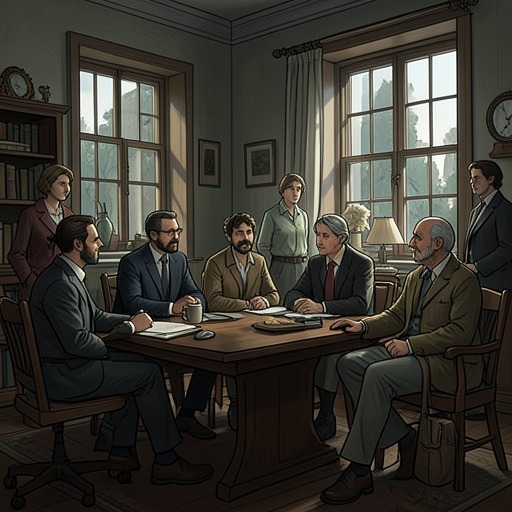
“Lantern-bearers”
Night and DayThe “Lantern-bearers” image arises as Katharine tries to make sense of the love and confusion binding the people around her. She imagines them carrying lights that scatter through a crowd, then weave together, dissolve, and meet again: an emblem of lives whose significance lies not in solitary certainty but in their changing relations. The image leads her toward a practical resolve—to further the aims of Mary Datchet, Ralph Denham, William Rodney, and Cassandra Otway, even when she cannot decide what action is unquestionably right.
The Image and Its Pattern
Thinking over Mary Datchet’s avowal of love, William Rodney’s unguarded emotion, and Ralph Denham’s strange, skyward intensity, Katharine sees the people in her circle as parts of a pattern. Their separate experiences seem to acquire a tragic beauty through their intersections. She pictures them as bearing splendid palaces on bent backs, then recasts them as “lantern-bearers,” whose lights, scattered among a crowd, join and separate in shifting combinations.
The image does not promise a stable design or a final resolution. Its lights meet and part; the pattern is made through movement. That form reflects Katharine’s perception of the relationships around her, which do not run in parallel but suddenly cross, leaving her to trace connections whose meaning remains uncertain.
From Reflection to Resolve
The metaphor changes the direction of Katharine’s thought. She decides that, whatever remains obscure, she must further the objects of Mary, Ralph, William, and Cassandra. Yet the resolve is not a settled plan: no course appears indubitably right, and she refuses to impose rules on herself or the others. Instead, she accepts unresolved difficulty and commits herself to fearless independence, believing this is the best way to serve the people who love.
The image therefore joins sympathy to action without making sympathy a claim of ownership or authority. Katharine cannot guarantee that her intervention will succeed; she can choose to stand with the people whose lives have become entangled with hers. The lanterns offer not a map out of uncertainty but a way to recognize connection within it.
Narrative Significance
“Lantern-bearers” gives visual form to the novel’s network of love and divided feeling. In Katharine’s mind, Mary, Ralph, William, and Cassandra become neither isolated romantic cases nor pieces of a pattern she can fully control. Their scattered lights make a composition that is continually dissolving and reforming, while her own place in it remains doubtful.
That uncertainty matters: Katharine even questions whether Ralph’s state of mind concerns her. Her commitment nevertheless widens beyond personal reassurance. The metaphor marks a movement from interpreting other people’s feelings toward accepting responsibility to support them, while preserving the independence to act without certainty about what the pattern ultimately means.